
Systemic Root Injection for Trees: What Property Managers and HOAs in Placer and Sacramento County Need to Know
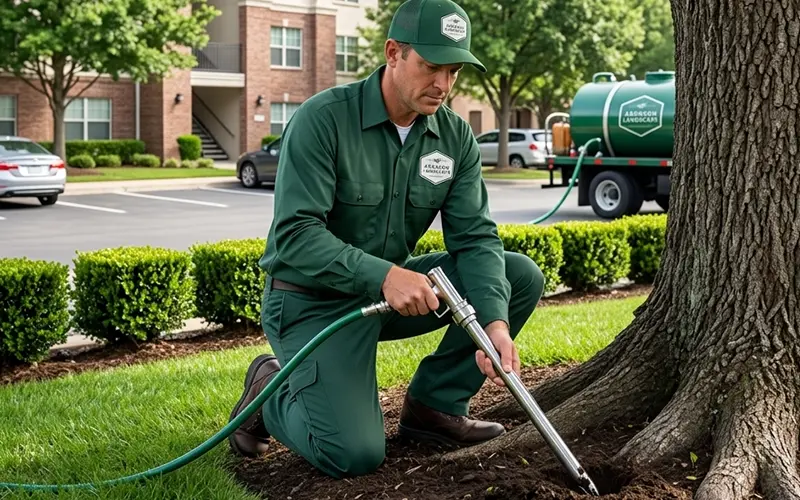
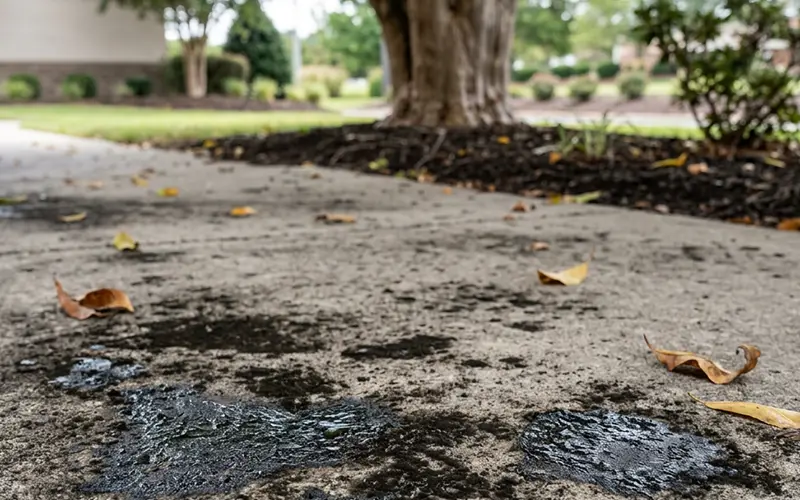
If you manage a multifamily community, HOA, or commercial property in Placer County or Sacramento County, you have probably dealt with at least one of these complaints: sticky sidewalks, black residue on parked cars, residents slipping near tree-lined walkways, or a persistent coating on outdoor furniture that no one can explain.
Most of the time, the source is the same. Pest activity in your trees — specifically aphids, soft scale, or mites — produces a sugary waste called honeydew. The residue lands on everything below, attracts ants, promotes sooty mold growth, and creates real liability and maintenance problems for your property.
The right solution is not a spray truck. It is systemic root injection: a targeted treatment method that delivers insecticide directly into the root zone, where it travels through the tree’s vascular system to where the feeding is happening. No drift. No disruption to residents. No repeated surface applications that wear off after rain. It is one of the most effective tools in a commercial landscape maintenance program for keeping your property’s tree canopy healthy and your common areas clean.
Quick Answer Summary
- What it does: Delivers a systemic insecticide or nutrient solution into the soil at the root zone. The tree absorbs it and moves it throughout its tissue — including the leaves where pest feeding occurs.
- What it treats: Aphids, soft scale, spider mites, whiteflies, and other sap-feeding insects that cause honeydew, leaf damage, and aesthetic decline.
- Why it matters for commercial properties: One treatment can provide season-long protection and eliminates the sticky walkway and car contamination complaints that generate repeated resident and tenant calls.
- When it is done: Preventatively in early spring before pest populations build, or curatively when a problem is already active.
- Who it is for: Property managers, HOA managers, apartment communities, and commercial property owners who need a low-disruption, high-efficacy solution.
What Is Systemic Root Injection and How Does It Work?
Systemic root injection places a measured dose of treatment product directly into the soil at the base of the tree, typically within the dripline or feeder root zone. From there, the tree’s natural water uptake process moves the product upward through the xylem and distributes it throughout the canopy.
Because the product travels inside the tree, it reaches feeding insects at their source — the leaf tissue, stems, and new growth where aphids, scale, and mites concentrate. It is not a surface coating that washes off. It is not a foliar spray that disperses into surrounding air. The treatment is contained, durable, and works with the tree’s biology rather than around it.
The most common active ingredient used for aphid and scale control is imidacloprid, a systemic insecticide that the University of California Integrated Pest Management Program identifies as especially effective for serious aphid infestations on woody ornamentals — particularly when biological controls alone are insufficient. For properties with pollinator concerns, timing and product selection are important factors that a qualified arborist manages carefully.
Root injection can also deliver:
- Macro and micronutrients to address iron chlorosis or soil deficiencies
- Biostimulants that improve root density and stress tolerance
- Fungicide treatments for specific foliar disease management
For most commercial and multifamily properties, the primary application is pest management — stopping honeydew production and the downstream problems it creates. This is a core component of any well-structured commercial landscape maintenance program in Sacramento and Placer County.
The Problem Systemic Treatment Is Actually Solving
Aphids, Scale, and Mites: The Sap Feeders
Aphids, soft scale insects, and spider mites feed by piercing plant tissue and extracting sap. They reproduce rapidly during warm weather and can colonize a large tree canopy before the infestation is even visible from the ground.
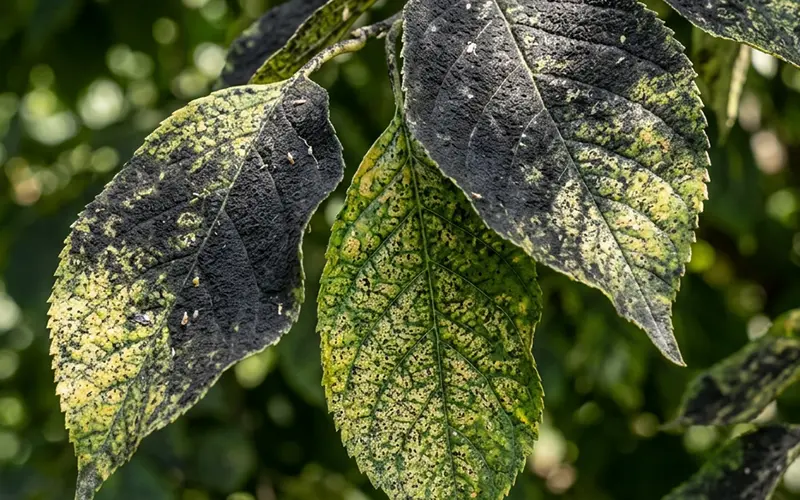
As they feed, aphids and scale insects excrete a sticky, sugar-rich liquid called honeydew. According to UC IPM’s guidance on soft scales in landscape settings, these insects feed on phloem sap and excrete abundant honeydew, which drips onto plants and surfaces below and promotes the growth of blackish sooty mold. Mites cause different visible damage — typically bronzing or stippling of leaves and early defoliation — but aphid and scale populations are the primary source of the sticky contamination that creates property management headaches.
What Honeydew Does to a Property
Honeydew drips from infested canopies onto everything below. On a multifamily property, that means:
- Sidewalks and entry paths become tacky and slippery, especially after morning dew
- Parked cars collect a sticky film that bakes on in summer heat
- Patio furniture, pool decks, and common area seating become unusable during peak infestation
- Sooty mold — a black fungal growth that colonizes honeydew deposits — forms on surfaces and on leaves, further degrading appearance
- Ants, which farm aphid colonies for honeydew access, trail aggressively through common areas
For HOA communities with high curb appeal expectations, for Class A apartment properties with premium amenity spaces, or for commercial properties trying to maintain a professional appearance, this is not a minor nuisance. It is a recurring maintenance problem with real costs: pressure washing, resident complaints, slip and fall liability, and declining property perception. If honeydew is also causing damage to sidewalks or walkways over time, our concrete repair and walkway services can address any surface damage as part of a broader property care plan.
Why Spraying Alone Does Not Solve It
Foliar spraying has a place in landscape pest management, but it has real limitations in dense residential and commercial environments:
- Spray applications require access restrictions during treatment and drying
- Wind drift is a genuine concern near parking structures, outdoor seating, pools, and pedestrian areas
- Contact insecticides applied to foliage kill surface populations but do not address insects feeding deep within canopy tissue or protected by waxy coatings — which is where soft scale thrives
- Most foliar treatments require repeat applications throughout the season because there is no residual protection inside the plant
- Resident and tenant exposure concerns generate complaints and sometimes service refusals on dense properties
Systemic root injection avoids nearly all of these issues. UC IPM notes that professional applicators using soil injectors achieve better control with less runoff potential compared to surface-applied products. It is applied at ground level, has no spray drift, requires minimal if any access restriction for residents, and provides lasting systemic protection through the tree’s own tissue.
Why Property Managers and HOAs Choose Systemic Treatment
One Treatment, Season-Long Protection
Depending on the product and method used, a single root injection in early spring can provide protective systemic activity throughout the growing season — sometimes longer for slow-feeding pests like scale. As UC IPM’s pest notes on scales confirm, one properly applied application of an effective systemic product may provide season-long control. This reduces service frequency, simplifies scheduling, and removes the reactive cycle of complaint, inspection, spray, and repeat.
For property managers juggling multiple service vendors across large communities, fewer interventions with greater effectiveness is a significant operational advantage. It is the kind of proactive, cost-effective approach that defines strong commercial landscape maintenance in Sacramento and Placer County.
Low Disruption to Residents and Tenants
Systemic root injection requires no canopy access, no spray equipment overhead, and no extended area closures. An experienced crew works at the base of each tree with a soil injection probe. In most settings, residents and tenants do not notice the treatment happening at all.
Compare that to aerial spray applications requiring signage, notifications, timed exclusions, and potential drift complaints. The operational and communication burden alone makes systemic injection worth considering on occupied properties. This is especially important for multifamily and HOA communities, where Aronson Landscape’s commercial landscape services are built around minimizing resident disruption while maintaining consistent property standards.
Protects Tree Health Over Time
Repeated heavy pest pressure weakens trees. Aphid and scale infestations stress the vascular system, reduce photosynthesis, and make trees more vulnerable to secondary problems including bark beetle activity, fungal disease, and heat stress. In the Sacramento Valley and Sierra foothill climate, trees already contend with drought stress, clay soils, and intense summer heat. Adding an unmanaged pest load to that pressure accelerates decline.
Preventative systemic treatment supports the long-term structural integrity and appearance of your tree canopy — which for many properties represents a significant asset and a major contributor to perceived property value. For properties where the full landscape services program includes ongoing tree maintenance, systemic injection fits naturally into an annual care calendar.
Addresses the Liability Question
Slip and fall incidents near honeydew-coated walkways are a real exposure for property owners and managers. A slick sidewalk under a heavy aphid infestation is not a hypothetical risk. Documenting a proactive pest management program that includes systemic treatment is meaningful evidence of reasonable care if an incident occurs. If surface damage has already occurred alongside pest issues, our team can assess whether concrete repair or trip hazard remediation is warranted as part of the same property visit.
How the Treatment Process Works on Commercial and Multifamily Properties
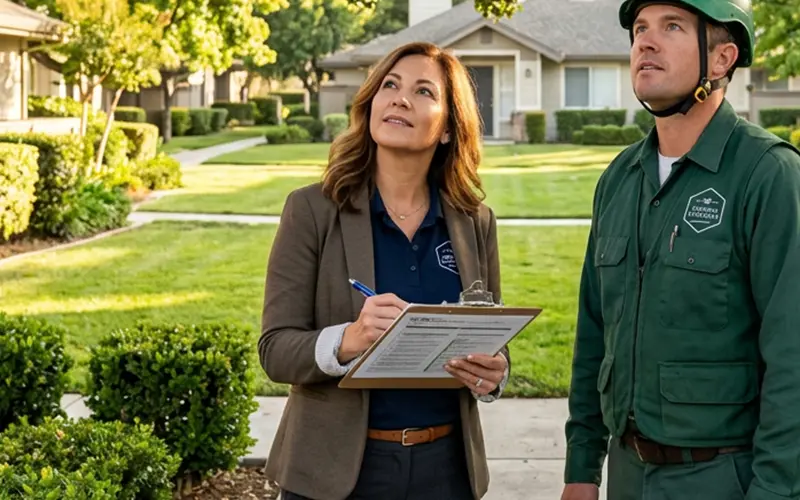
Initial Assessment
Before any injection is performed, a qualified arborist or licensed applicator evaluates the tree species, canopy condition, pest pressure, soil type, and proximity to water features, turf irrigation, or sensitive plantings. Not every tree is a candidate for every systemic product, and species that are wind-pollinated or in flower should be treated at appropriate times to minimize pollinator exposure.
On large properties, this assessment also identifies which trees are highest priority based on canopy size, location over pedestrian areas, history of complaint, and aesthetic importance. This kind of site-level planning is also the starting point for Aronson Landscape’s broader commercial landscape design and maintenance work across Placer and Sacramento Counties.
Product Selection and Dosing
Product and rate are calculated based on trunk diameter and tree health status. Common active ingredients include imidacloprid for broad-spectrum sap-feeder control and dinotefuran for faster uptake when curative speed is needed. UC IPM’s pest notes on scales confirm that neonicotinoids vary in effectiveness depending on the scale type — imidacloprid controls soft scales effectively but does not control armored scales, which is one reason professional product selection matters.
For properties with documented sensitivity concerns around pollinators or specific pest resistance patterns, alternative product chemistries are available. A professional service provider will match product selection to the property’s specific needs rather than applying a one-size solution.
Application
Injection is performed using a soil probe inserted at intervals around the base of the tree within the feeder root zone. Product is released under controlled pressure directly into the active root layer where uptake is fastest. The process is quiet, ground-level, and typically takes only a few minutes per tree.
No irrigation is required afterward in most cases, though some products benefit from normal post-application watering to assist movement through the root zone.
Follow-Up and Monitoring
Results are not instantaneous. Systemic uptake through a large tree canopy typically takes two to four weeks to reach full efficacy. During that window, some pest activity will continue before populations collapse. Setting appropriate expectations with property stakeholders is part of professional service delivery.
Follow-up monitoring confirms treatment success and identifies whether additional intervention is needed for persistent populations or secondary pest species. This ongoing attention is built into Aronson Landscape’s landscape service programs for Placer and Sacramento County properties.
Timing: Why Preventative Treatment Beats Reactive Treatment
In Placer County and Sacramento County, the pest management calendar for aphids, scale, and mites follows a predictable pattern. Populations begin building in late February and March as temperatures climb, and they can reach damaging levels by April and May — well before most properties notice or report a problem.
By the time honeydew is dripping onto walkways, pest populations are already large and the tree has already experienced weeks of feeding stress. Reactive treatment still works, but it requires a longer uptake window to show results, and the property has already absorbed weeks of resident complaints, slippery surfaces, and sooty mold development.
Preventative injection in late winter or very early spring — before pest pressure builds — allows the product to establish systemic concentration in the canopy in advance of peak feeding activity. UC IPM’s guidance on aphid management in landscape settings notes that summer heat in the Central Valley and desert areas does reduce many aphid populations — but populations can still reach damaging levels in spring before that natural suppression kicks in. The result of early treatment is a season where the problem never materially develops rather than a season spent chasing it.
For properties with a documented history of aphid or scale problems on specific trees, there is almost no good argument for waiting until the problem recurs. Planning this as part of your annual commercial landscape maintenance calendar is the most cost-effective approach.
What Property Managers Should Know Before Scheduling Service
Know your tree species. Certain species are far more prone to aphid and scale problems than others. In the Sacramento region, common problem species include Chinese pistache, liquidambar, ash, crape myrtle, and various ornamental pear varieties. If your property has these trees positioned over parking or pedestrian areas, they warrant proactive attention. UC IPM’s black scale pest notes list pistachio, maple, and many other common landscape trees as primary hosts — species that appear regularly on commercial properties throughout our region.
Understand timing restrictions for flowering trees. Systemic products applied to flowering trees during bloom period can pose pollinator risks. UC IPM specifically advises against applying imidacloprid or other systemic insecticides to plants in bloom or prior to bloom to protect pollinators. A professional applicator manages this, but it is worth discussing when scheduling.
Ask about water feature and irrigation proximity. Some systemic products carry label restrictions near water features or heavily irrigated turf. A qualified applicator knows these restrictions and plans accordingly. Aronson Landscape’s irrigation and landscape services team can evaluate your property’s layout as part of pre-treatment planning.
Set expectations for timeline. Systemic treatment is not a same-day solution for an active infestation. Communicate a two to four week efficacy window to residents or facility stakeholders so expectations are managed appropriately.
Combine with overall tree care planning. Systemic injection is most effective as part of an integrated tree care program that also addresses pruning, irrigation, and soil health. Trees under compaction stress, irrigation stress, or nutrient deficiency are more vulnerable to pest pressure and less responsive to treatment. Addressing those underlying factors improves outcomes. See how Aronson Landscape approaches full-property commercial landscape maintenance for HOAs and multifamily communities in Placer and Sacramento Counties.
Common Mistakes Property Managers Make With Tree Pest Problems
Waiting for multiple complaint cycles before acting. By the time residents are submitting formal complaints, the infestation is already at peak intensity and the visible damage is already done. Establish a proactive monitoring and treatment calendar instead.
Treating symptoms instead of causes. Pressure washing honeydew and sooty mold from sidewalks is necessary maintenance, but it does not address the tree canopy overhead. Without pest management, the sidewalk will be recontaminated within days. If surface damage is significant, concrete repair and walkway maintenance may also be warranted alongside the tree treatment.
Relying exclusively on foliar spray in occupied environments. Foliar applications have a place, but they should not be the default method on properties where resident exposure, drift concerns, and access restrictions create operational challenges. Systemic root injection is often a better fit.
Applying general-purpose pesticides without a licensed applicator. Commercial landscape pest management in California requires a Pest Control Adviser or Qualified Applicator License. Using unlicensed or improperly trained staff creates liability and often produces ineffective results.
Ignoring tree health in the off season. Summer heat stress, compacted soils, and deferred pruning all weaken trees and make them more susceptible to aphid and scale colonization the following spring. Fall and winter are the right time to address these factors. An ongoing year-round commercial landscape maintenance program keeps these risks in check across all seasons.
Frequently Asked Questions
What is systemic root injection for trees?
Systemic root injection is a method of delivering pest control products, fertilizers, or other treatments directly into the soil at a tree’s root zone. The tree absorbs the product through its roots and distributes it throughout its vascular system — including the canopy where insects feed. It is a more targeted and durable method than foliar spraying for many pest problems. The University of California IPM Program recognizes soil injection by professional applicators as providing better control with less runoff potential than surface-applied systemic products.
Why are my sidewalks sticky near certain trees?
Sticky sidewalks near trees are almost always caused by honeydew, a sugary liquid excreted by sap-feeding insects such as aphids, soft scale, or whiteflies living in the tree canopy. The insects feed on tree sap and excrete the excess sugar, which drips onto surfaces below. Systemic treatment of the affected trees eliminates the pest population and stops honeydew production. If the walkway surface itself has been damaged, concrete repair may also be needed.
Is systemic root injection safe for residents and pets on a multifamily property?
When applied by a licensed and trained applicator following label directions, systemic root injection presents very low risk to people and pets in common areas. Because product is applied at ground level into the soil rather than sprayed overhead, there is no airborne exposure during application. Standard precautions typically involve avoiding the immediate treatment area while the applicator is working.
How long does systemic root injection last?
Duration depends on the product used, tree species, and pest target. For aphid and scale management using imidacloprid, a single application can provide protection for one full growing season. UC IPM’s scale management guidelines confirm that one properly applied treatment may provide season-long control, though some products provide protection into a second season for slow-developing pests like scale. Your tree care provider will recommend a schedule based on your specific trees and pest history.
Can root injection treat aphids, scale, and mites at the same time?
Systemic insecticides used in root injection are broadly effective against most sap-feeding insects, including aphids, soft scale, and whiteflies. Spider mites are more variable, as some systemic products have limited efficacy against them. It is also worth noting that imidacloprid controls soft scales but does not control armored scales — another reason professional product selection and pest identification matters before treatment begins.
When is the best time to schedule preventative root injection in Sacramento or Placer County?
The optimal timing for preventative injection targeting aphids and scale is late winter to early spring — generally late February through mid-March in the Sacramento Valley and Sierra foothill regions. This allows the product to establish in the canopy before pest populations begin building with warmer temperatures. Treating after populations have peaked is still effective but takes longer to show results. Contact Aronson Landscape in late fall or early winter to get on the treatment schedule before spring.
Does systemic root injection harm the tree?
No. Systemic root injection, when performed correctly with appropriate products and dosing, does not harm healthy trees. It delivers product in a controlled, measured way that works with the tree’s natural biology. Improper dosing or using products not labeled for the target species can cause stress, which is why professional, licensed application matters.
Why should I treat trees preventatively instead of waiting for a problem?
Reactive treatment works, but it means your property has already experienced weeks of honeydew drip, resident complaints, slippery walkways, and sooty mold development before results are visible. Preventative treatment in early spring stops the problem from materializing at a property-visible level. For occupied multifamily communities and commercial properties where appearance and resident experience matter, preventative treatment consistently delivers better outcomes. It is a foundational part of any well-run commercial landscape maintenance program in Placer and Sacramento County.
Will root injection help with ants around my trees?
Ants near aphid-infested trees are typically farming the aphids for their honeydew and are not the primary problem. UC IPM notes that ants ward off natural predators of aphids, which actually worsens infestations over time. Eliminating the aphid population through systemic treatment removes the ants’ food source, which typically causes ant activity in the area to drop significantly without requiring separate ant control.
About Aronson Landscape
Aronson Landscape is a full-service commercial landscape and tree care company serving property managers, HOA communities, multifamily properties, and commercial owners throughout Placer County and Sacramento County. Founded in 2007, our team includes licensed professionals with deep experience in tree health, integrated pest management, and the operational demands of occupied commercial and residential properties.
We understand what it means to manage a high-visibility property where appearance, safety, and resident experience are not abstract goals. Our commercial landscape programs are built around preventative thinking, sound horticulture, and clear communication with the property teams we support.
From systemic root injection and structural pruning to seasonal landscape programs and irrigation management, Aronson Landscape provides the expertise and consistency that commercial properties require. View our commercial landscaping gallery to see examples of our work across Northern California.
Ready to Stop the Sticky Walkway Cycle?
If your property has trees positioned over parking, walkways, common areas, or amenity spaces — and you have dealt with honeydew, sticky surfaces, or pest-related complaints before — the right conversation to have is about prevention, not reaction.
Contact Aronson Landscape to schedule a property assessment. We will evaluate your trees, identify pest risk by species and location, and recommend a systemic treatment program that fits your property’s needs and budget.
Serving Placer County and Sacramento County | Call (916) 243-9350