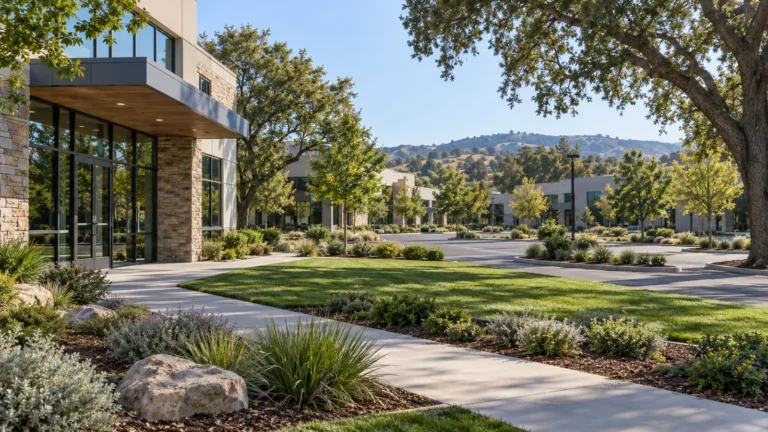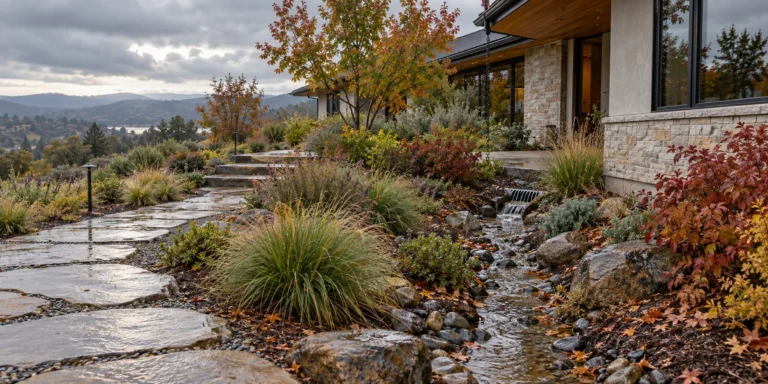
Quick answer: A strong commercial landscape maintenance contract spells out the exact scope of work, visit frequency, irrigation management responsibilities, tree and pest control rules, seasonal tasks, reporting, and how extra work is approved and billed. For HOAs, office parks, retail centers, and multifamily communities in Placer County and Sacramento, the details in writing matter more than the monthly price.
Property managers in Loomis, Rocklin, Roseville, Lincoln, Auburn, Granite Bay, and Sacramento often inherit a landscape contract that says little more than “mow, blow, and go.” That works until a broken lateral line floods a parking lot, a tree limb drops near an entrance, or a board member asks why the water bill doubled. This guide walks through what a commercial landscape maintenance contract should include in 2026, the questions to ask before you sign, and the red flags to watch for.
What does commercial landscape maintenance cover?
Commercial landscape maintenance is the recurring care of the grounds around a business or shared property: turf, shrubs, trees, groundcover, irrigation, hardscape edges, and the litter and debris that collect around them. It is different from a one-time installation or a renovation project. The goal is a site that stays safe, presentable, and water-efficient month after month. For an overview of our recurring service itself, see commercial landscape maintenance in Sacramento and Placer County.
On our commercial landscaping services page, we list the maintenance tasks we perform for commercial clients, including lawn care, irrigation system maintenance, fertilization programs, plant trimming and shrub pruning, seasonal color replacement, tree maintenance, weed removal, landscape drainage, lighting and water feature maintenance, and trash removal. A good commercial landscape maintenance contract names each of these that applies to your site rather than lumping them under “general maintenance.”
Who needs a written contract?
- HOAs that must show the board and residents what they are paying for.
- Office parks and corporate campuses where first impressions affect tenants and leasing.
- Retail centers where sight lines, signage visibility, and walkway safety matter daily.
- Apartment and multifamily communities with heavy foot traffic and resident requests.
- Property managers who oversee several sites and need consistent reporting.
What to put in a commercial landscape maintenance contract
Use this commercial landscape maintenance contract checklist when you request bids or review a renewal. If an item is missing, ask the vendor to add it in writing.
| Contract item | What it should say | Why it matters |
|---|---|---|
| Scope of work by area | Turf, shrub beds, trees, slopes, parking islands, and entries listed with tasks for each | Prevents “that wasn’t included” disputes |
| Visit frequency | Days per week or month, plus how the schedule changes by season | Lets you verify service was delivered |
| Mowing and edging | Mowing height range, edging of walks and curbs, clippings handling | Turf health and a clean look |
| Pruning standards | Shrub shaping, clearance at walks and signs, who handles trees above a set height | Safety, visibility, and plant health |
| Weed and pest control | IPM approach, who applies products, licensing, notification and records | Legal compliance and resident safety |
| Irrigation management | Controller programming, inspection frequency, repair limits, leak response time | Water cost and plant survival |
| Seasonal color | Number of rotations per year and bed locations, or “billed separately” | Budget clarity |
| Leaf and storm cleanup | What is included after normal leaf drop versus a major storm | Avoids surprise invoices |
| Equipment | Plan for compliant, quieter equipment where your site requires it | Noise complaints and state rules |
| Reporting | Visit logs, photos, irrigation notes, and a named point of contact | Accountability for boards and owners |
| Extra work approval | Written proposals and a dollar threshold before work starts | Keeps enhancements under control |
| Insurance and license | Contractor license number, proof of insurance, pesticide licensing if applicable | Protects the property owner |
| Term and termination | Contract length, notice period, and performance standards | Lets you exit if service slips |
Irrigation management: the biggest line item you can’t see
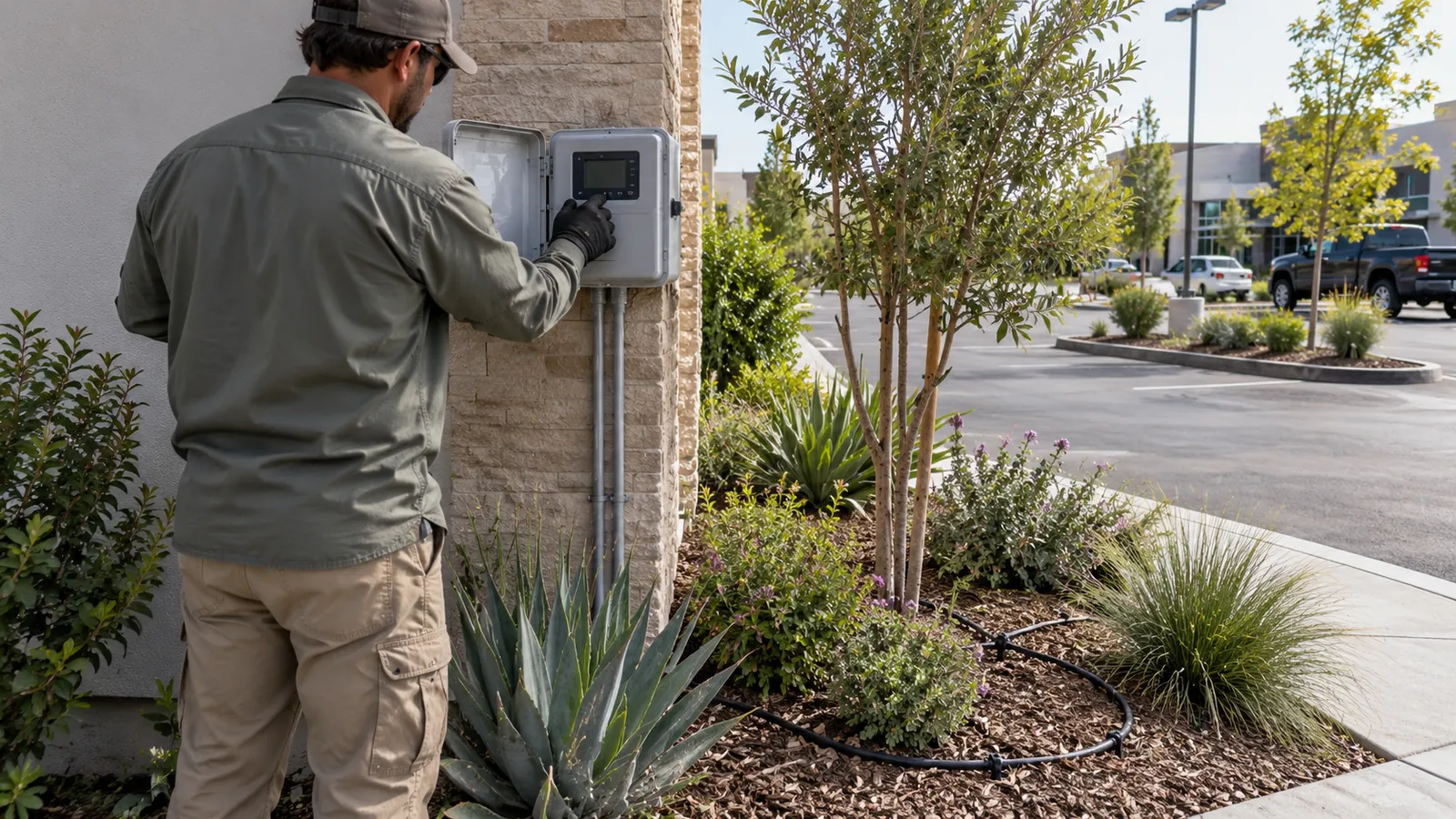
On most commercial sites in our area, irrigation is where a commercial landscape maintenance contract saves or wastes the most money. Water runs before dawn, so a broken head or stuck valve can go unnoticed for weeks unless someone is assigned to check.
California MWELO and local water rules
California’s Model Water Efficient Landscape Ordinance (MWELO) from the Department of Water Resources sets water efficiency standards for landscapes. According to DWR, it applies to new construction projects with 500 square feet or more of landscape area and rehabilitated landscapes of 2,500 square feet or more that require a permit, plan check, or design review. Cities and counties adopt MWELO or a local ordinance that is at least as effective.
In a commercial landscape maintenance contract, this means two things. If your property is planning a renovation, the new landscape may need to meet those standards. And if your site was built to MWELO, the maintenance crew should keep the irrigation working the way it was designed, not switch drip zones back to spray or let controllers run on a fixed summer schedule all year.
Smart controllers and rebates
Weather-based controllers adjust run times as conditions change. The EPA keeps a list of WaterSense labeled irrigation controllers that meet its efficiency criteria. Some local water providers help pay for upgrades. For example, the Placer County Water Agency rebate programs page lists rebates for commercial customers who replace a controller with a WaterSense approved weather-based model, upgrade in-ground irrigation, or replace lawn with water-efficient landscaping. Program terms change, so confirm eligibility with your own water provider, since Roseville, Sacramento, and other cities run their own utilities.
Your contract should say who programs the controller, how often each zone is inspected in the irrigation season, how quickly leaks are fixed, and what repair cost the crew can approve without asking. For a deeper look, see our guide to commercial irrigation management in Placer County and our post on commercial irrigation repair in Sacramento.
Tree care, pest control, and licensing
Trees are often the highest-liability plants on a commercial property. Many commercial landscape maintenance contracts cover low pruning and leave larger trees to a separate proposal. That is fine, as long as the commercial landscape maintenance contract says so and someone is responsible for flagging dead limbs, root damage to sidewalks, and clearance over drive aisles. Our article on systemic root injection for trees explains one treatment option for stressed trees.
Integrated pest management (IPM)
In commercial landscape maintenance, an IPM approach combines monitoring, cultural practices, and targeted treatment instead of routine spraying. UC IPM’s home and landscape resources are a practical reference for weeds, insects, and plant diseases common in California landscapes.
If your vendor applies pesticides, including many herbicides, ask about licensing. The California Department of Pesticide Regulation states that the state requires a license or certification for many categories of professional applicators and for businesses that apply pesticides, including maintenance gardener pest control businesses. Ask which license the company holds and request application records for your site.
Equipment rules: gas blowers and mowers in 2026
California’s small off-road engine rules affect commercial landscape maintenance equipment purchases. According to the California Air Resources Board, emission standards for most new small off-road engines, such as those in leaf blowers and mowers, are zero starting with model year 2024, with zero-emission standards for portable generators and larger pressure washers beginning with model year 2028. CARB notes the rule applies to new equipment from manufacturers. Existing compliant gas equipment can still be used.
For property managers, the practical question is noise and timing. Ask whether the crew uses battery equipment near offices, patios, or residential buildings, and set service windows in the commercial landscape maintenance contract.
Fire-safe maintenance in the foothills
Properties near open space in Auburn, Loomis, Granite Bay, and other foothill areas should treat vegetation management as a safety task. CAL FIRE describes defensible space in zones that extend up to 100 feet from structures, with the closest zone focused on removing dead plants, leaves, and other debris that can catch embers. A commercial landscape maintenance contract can include dry-season cleanup of dead material, leaf removal from roofs and gutters where reachable, and clearance around buildings.
A seasonal calendar for Placer County properties
Our climate swings from wet winters to long, hot summers. A good commercial landscape maintenance contract shifts with it.
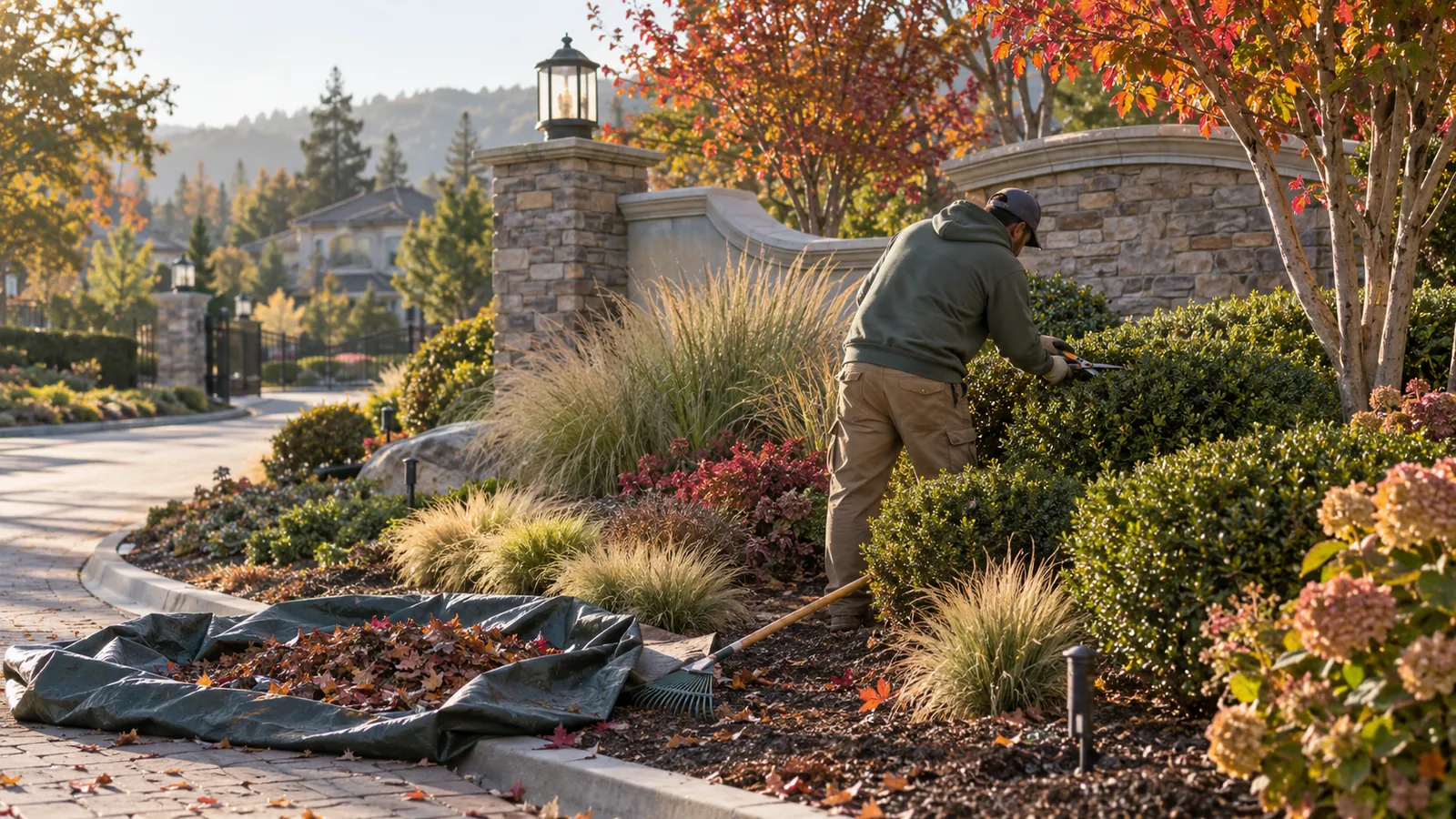
- Fall (September–November): Leaf cleanup, cool-season color, fall fertilization where appropriate, clearing drains before the first storms, and reducing irrigation as days shorten.
- Winter (December–February): Storm debris cleanup, checking drainage and erosion on slopes, dormant pruning, and turning irrigation down or off during rain.
- Spring (March–May): Irrigation startup and zone-by-zone inspection, weed control before seeds set, mulch refresh, and spring color.
- Summer (June–August): Frequent irrigation checks during heat, mowing height adjustments, shade and stress monitoring for trees, and fire-season cleanup of dry material.
Our rain-ready fall plan for Placer County covers the drainage side of this calendar in more detail.
Pricing models in a commercial landscape maintenance contract
Bids are easier to compare when you know which pricing model each vendor is using:
- Fixed monthly fee: A set price for the scope listed in the commercial landscape maintenance contract. Predictable for budgets, but only as good as the scope definition.
- Time and materials: Billing by labor hours and materials used. Flexible, but harder to forecast and verify.
- Base contract plus enhancements: A fixed fee for routine care, with irrigation repairs beyond a set limit, seasonal color, tree work, and upgrades proposed and billed separately.
Many properties use the third model in their commercial landscape maintenance contract. Whatever you choose, the commercial landscape maintenance contract should state what is included, what is extra, and the approval process for extras. Cost depends on site size, plant mix, irrigation condition, and visit frequency, so be cautious of any price quoted without a site walk.
Questions to ask a commercial landscaper
Before you sign a commercial landscape maintenance contract, ask every bidder the same questions so you can compare answers side by side.
- What is your California contractor license number, and can you provide proof of insurance?
- Who will be my point of contact, and how fast do you respond to service requests?
- How often will the crew inspect irrigation zones, and how are repairs approved?
- Do you hold the required pesticide license, and do you follow an IPM approach?
- Which tasks are included, and which are billed separately?
- What reports or photos will I receive after visits?
- How do you handle storm cleanup and emergencies?
- Can you take over a site with deferred maintenance, and what does that transition look like?
Red flags in a commercial landscaping bid
- A one-paragraph commercial landscape maintenance contract scope with no visit frequency.
- No mention of irrigation inspection or who programs the controllers.
- Vague answers about pesticide licensing or insurance.
- Unlimited “extras” with no approval threshold.
- Long auto-renewal terms with no performance standards or exit clause.
- A price far below other bids without a clear reason, which often means fewer visits or skipped tasks.
Commercial landscape maintenance near you
We provide commercial landscape maintenance across Placer County and in Sacramento County. See how we work in Roseville, Rocklin, Lincoln, Loomis, Auburn, and Granite Bay, or view all service areas. A good commercial landscape maintenance contract also looks ahead. If you are weighing lower-water plantings during a renovation, our low maintenance landscaping ideas share principles that also apply to common areas.
About Aronson Landscape
Aronson Landscape Inc. is a licensed and insured, owner-operated landscaping and concrete contractor founded by Levi Aronson in 2007 (California contractor license #974133). We provide commercial landscape maintenance, design, and installation, residential landscaping, and concrete services for office parks, retail centers, HOAs, apartment and multifamily communities, medical facilities, schools, and other properties across Placer County and the Sacramento area. Estimates are free, and maintenance clients are covered by the Aronson Guarantee: if you are not completely satisfied and do not see an improvement in your property’s appearance in the first 30 days, your first month of maintenance is free. Learn more about our team.
Ready to review your current contract or get a new bid? Call 916 243 9350 or request a free commercial landscape maintenance estimate.
Frequently Asked Questions
What should a commercial landscape maintenance contract include?
It should list the scope by area, visit frequency, mowing and pruning standards, weed and pest control, irrigation management, seasonal and storm cleanup, reporting, insurance and license details, how extra work is approved, and the commercial landscape maintenance contract term and exit terms.
How often should a commercial landscaper visit my property?
Commercial landscape maintenance schedules depend on the site, plant mix, and season. High-traffic retail and multifamily sites often need more frequent visits than a small office. Your commercial landscape maintenance contract should state the schedule and how it changes between summer and winter.
Is irrigation repair included in commercial landscape maintenance?
Routine inspection and minor adjustments are often included, while larger repairs are proposed and billed separately. Your contract should name the repair limit the crew can approve and the response time for leaks.
Do landscapers need a license to spray weeds on commercial property?
California DPR requires a license or certification for many professional applicators and for businesses that apply pesticides for hire, including maintenance gardener pest control businesses. Ask your vendor which license applies to their work.
Can landscapers still use gas leaf blowers in California?
CARB’s rules require most new small off-road engines to meet zero-emission standards starting with model year 2024. Existing compliant gas equipment can still be operated, but many crews are adding battery equipment.
Which areas does Aronson Landscape serve for commercial maintenance?
We serve Roseville, Rocklin, Lincoln, Auburn, Loomis, Granite Bay, and the rest of Placer County, plus commercial properties in Sacramento County.